
Partial or Total Knee Replacement?
One damaged part of the knee does not always mean the whole knee needs replacing. How surgeons decide between a partial and a total knee replacement.
Share on WhatsAppWhen people hear that they need a knee replacement, most imagine the whole knee being replaced. But one damaged part of the knee does not necessarily mean the whole knee is damaged.
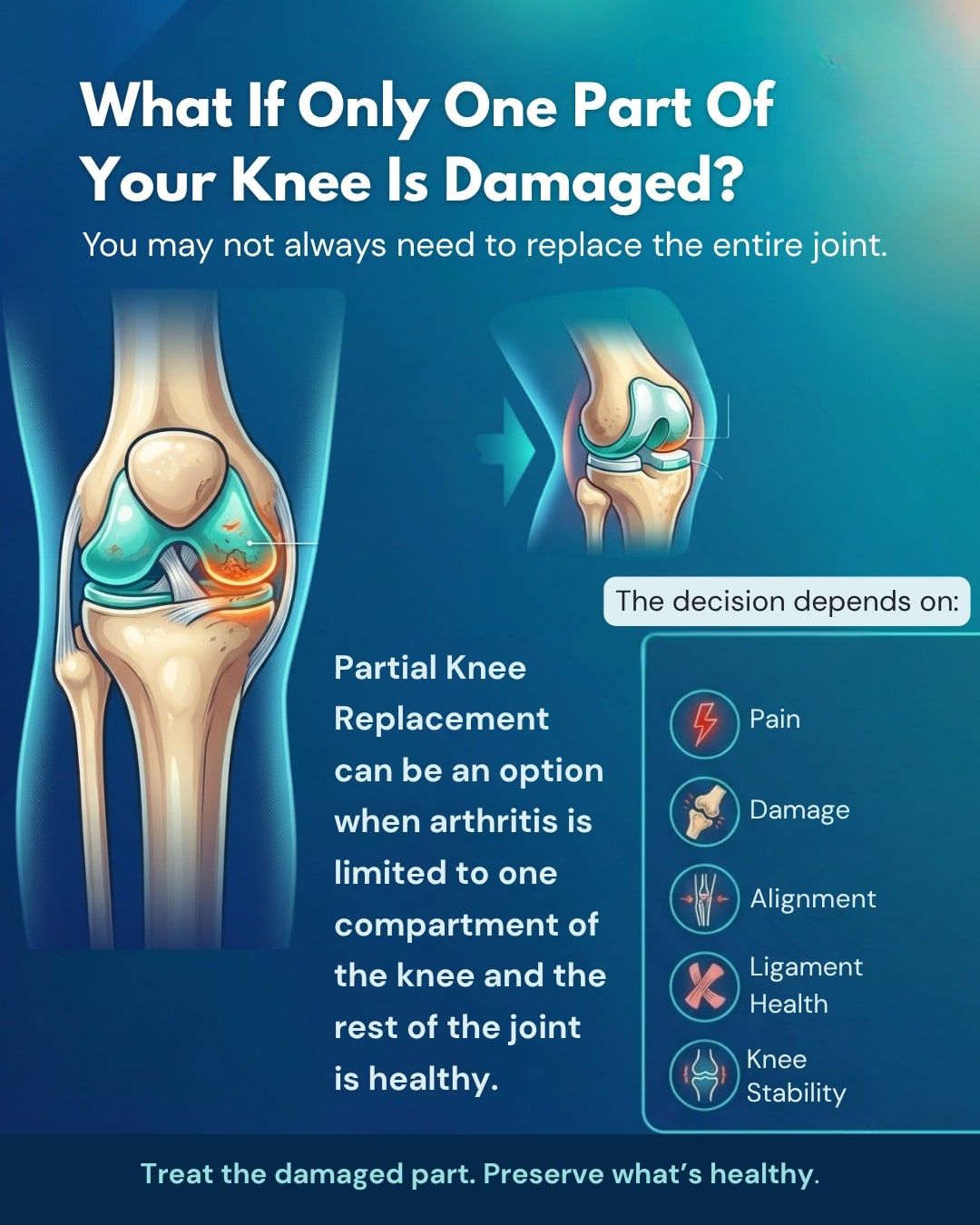
For carefully selected patients with arthritis limited to one part of the knee, a partial knee replacement may be an option.
The Knee Has Three Parts
Your knee can be thought of as three compartments:
- The inner side (medial compartment), where arthritis most often starts
- The outer side (lateral compartment)
- The front, between the kneecap and the thighbone (patellofemoral compartment)
In a total knee replacement, the surfaces of the whole joint are replaced. In a partial knee replacement, only the worn compartment is resurfaced, and the healthy cartilage, bone and ligaments are kept.
How Much Pain Is Not the Only Question
The important question is not simply, “How much pain are you in?” It is also: where is the damage, and is the rest of the knee healthy?
The decision depends on:
- Where the arthritis is. Standing X-rays, and sometimes special stress views, show which parts of the knee are worn.
- The ligaments. The knee’s own ligaments, especially the ACL, need to be healthy for a partial replacement to work well.
- Alignment. A knee that is badly bent inwards or outwards may need a total replacement to correct it.
- Movement. The knee needs to bend and straighten reasonably well.
- The type of arthritis. Inflammatory arthritis, such as rheumatoid arthritis, usually affects the whole knee.
- Your activity and expectations. What you want to get back to matters.
The Benefits of a Partial Replacement
When it is the right choice, a partial knee replacement usually means a smaller incision, less blood loss, less pain, a shorter hospital stay and a quicker recovery. Many people say the knee feels more natural, because so much of their own knee is kept.
The Trade-Offs
Because the rest of the knee is still your own, arthritis can later develop in another part of it. If that happens, the partial replacement can be converted to a total replacement in a planned operation. A partial replacement also depends on careful patient selection and precise surgery.
So Which Is Right for You?
The goal is simple: treat the damaged part and preserve what is healthy, when that is the right choice for your knee. If the damage is spread across the knee, a total replacement gives a more reliable result.
Dr. Gadkari examines the knee, checks the ligaments and studies your X-rays before recommending either operation, and explains why one suits your knee better than the other. Read more about joint replacement surgery, or book a consultation to have your knee assessed.
General information, not advice for your own joint. See our medical disclaimer.
Book a Consultation
Talk to Dr. Gadkari about knee replacement. Message the clinic on WhatsApp or call, and they will find a time and place that suits you.
Pending Medical Review: Dr. Gadkari has not yet approved this page.